Launch offer — valid today only

📄 Digital book in PDF · read it on your phone or print it

The Water and Wastewater Operator Exam, Illustrated Every Topic on One Page, Every Math Problem in the Same 4 Steps

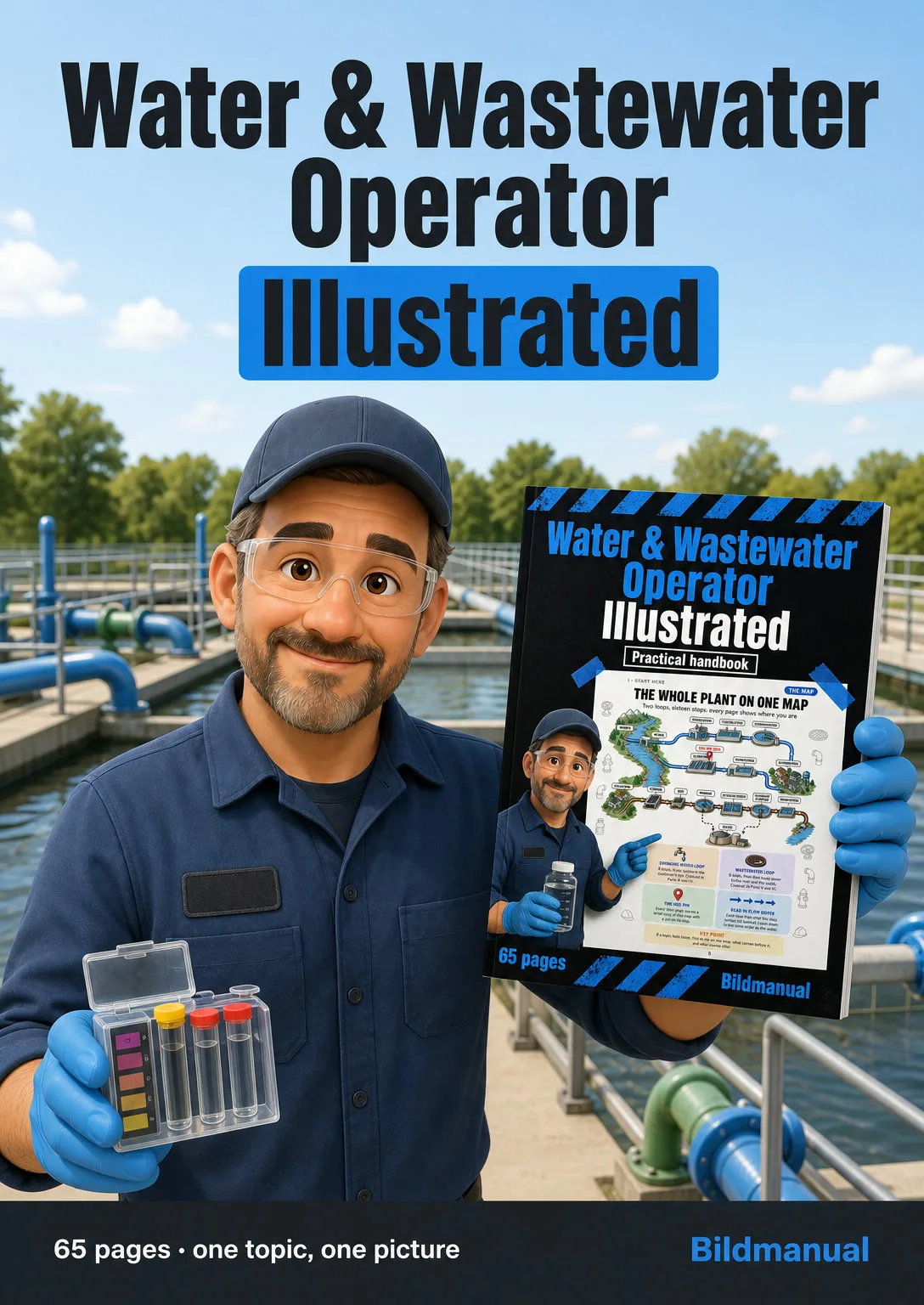
For drinking water and wastewater operators going for Grade I or II. The whole plant on one map, operator math worked step by step, treatment, distribution rules, activated sludge, pumps, lab tests and safety. Each topic gets its own page: the drawing first, then what you need to remember. 65 illustrated pages.

GET THE ILLUSTRATED BOOK

🔒 Secure checkout · PDF by email · 30-day guarantee

Every topic, its own pageEach stage of the plant drawn, with the explanation right beside it
65 illustrated pages8 parts, from the whole plant on one map to the night-before checklist
Up-to-date sourcesEPA 40 CFR Parts 141 and 133, OSHA 29 CFR 1910
PDF by emailFormat

Look Inside the Book

Every page has one big drawing and a box with the numbers and formulas you need to know:

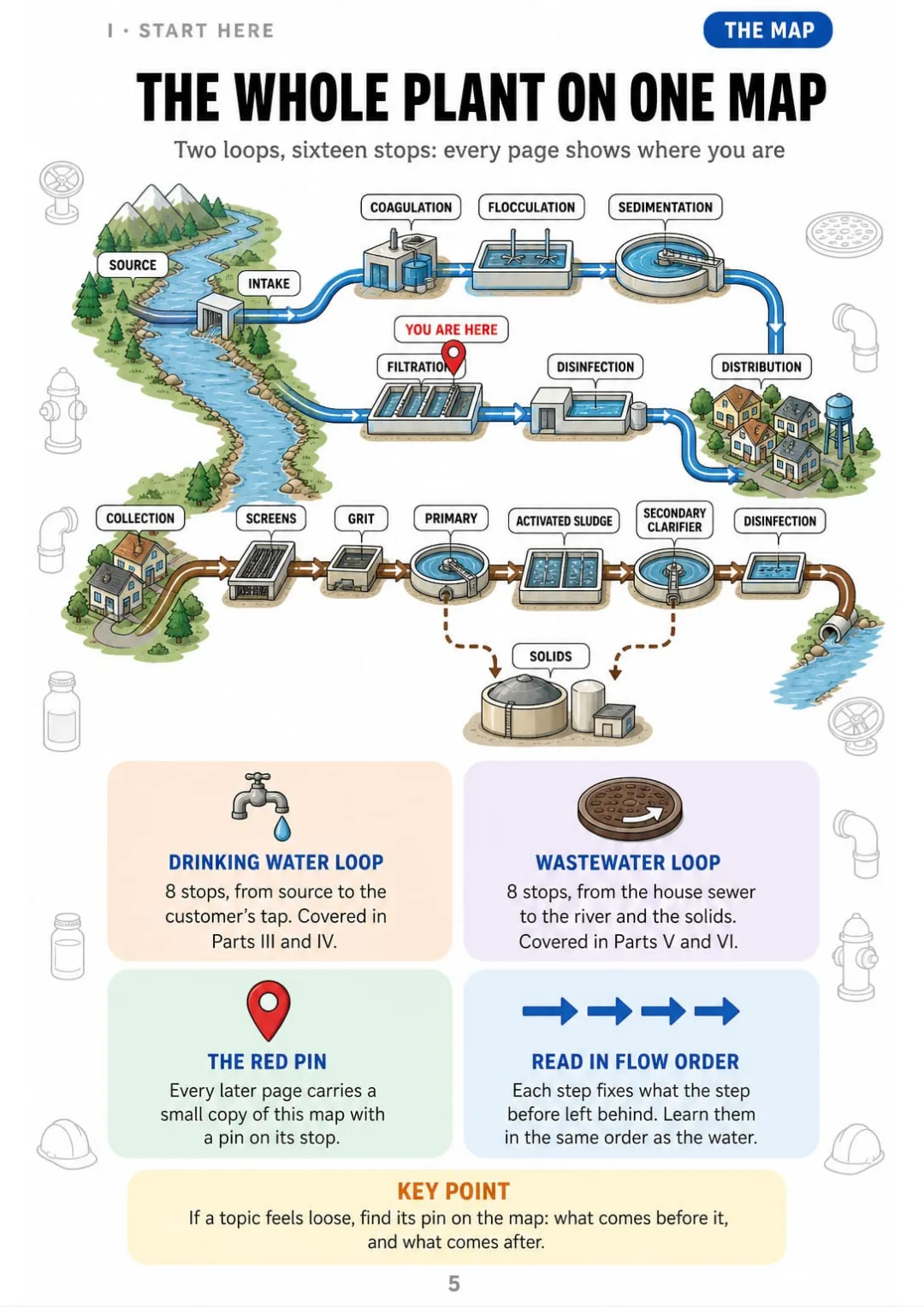
Drinking water and wastewater: 2 loops, 16 stops, one map
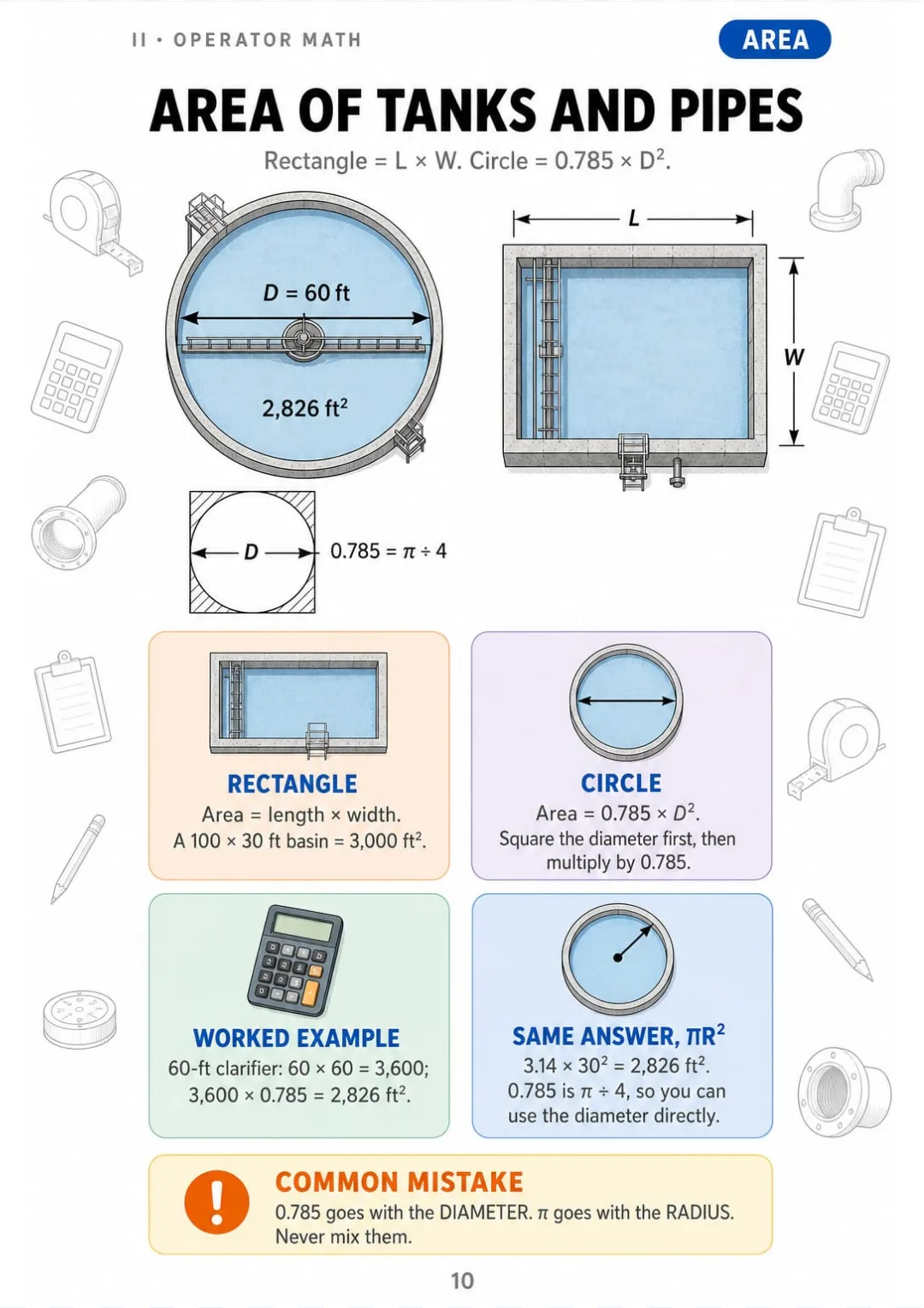
60-ft clarifier: 0.785 × 60² = 2,826 ft², same as π × 30².
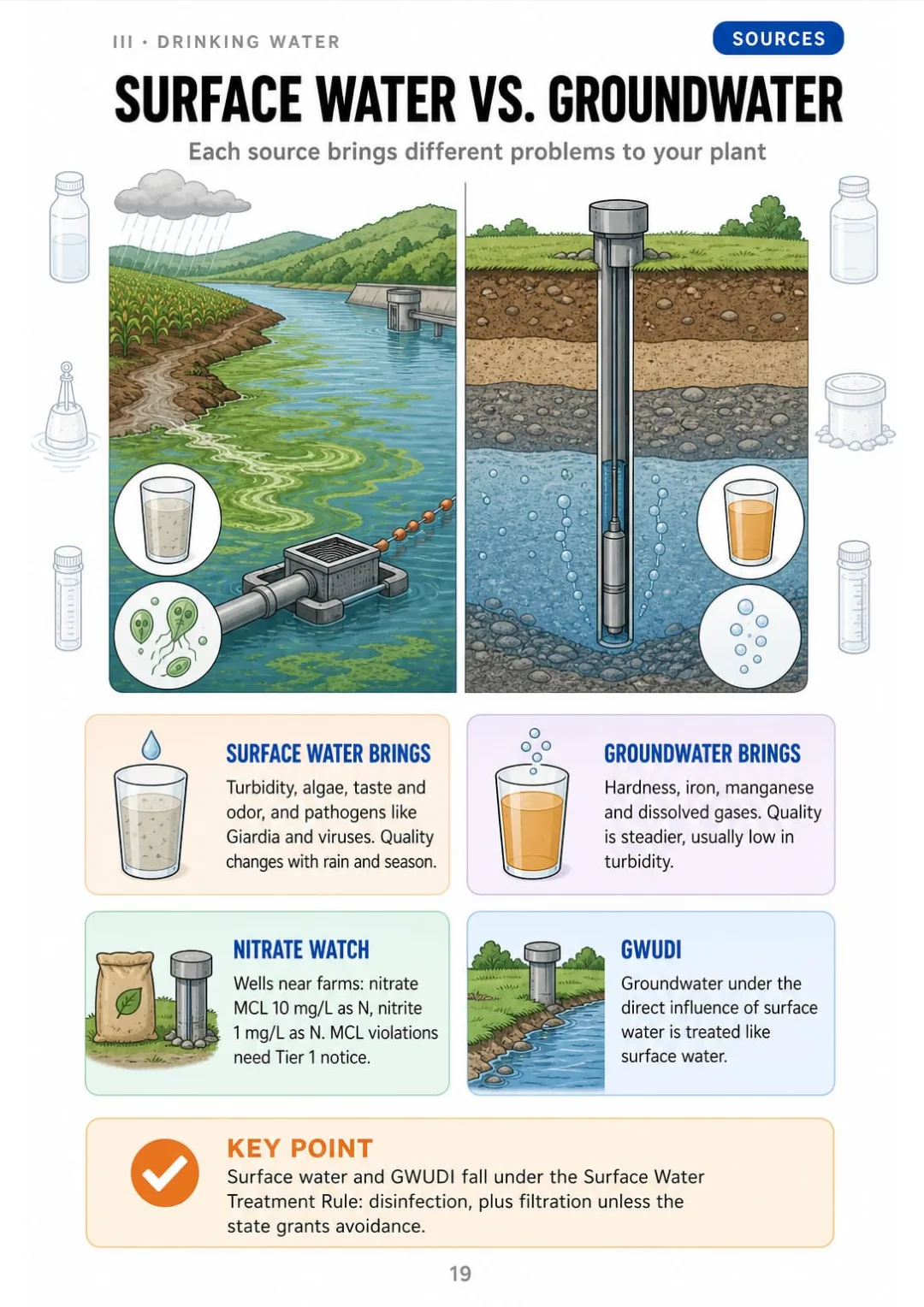
Surface water: turbidity and pathogens · Groundwater: hardness, iron, manganese · GWUDI = surface rules
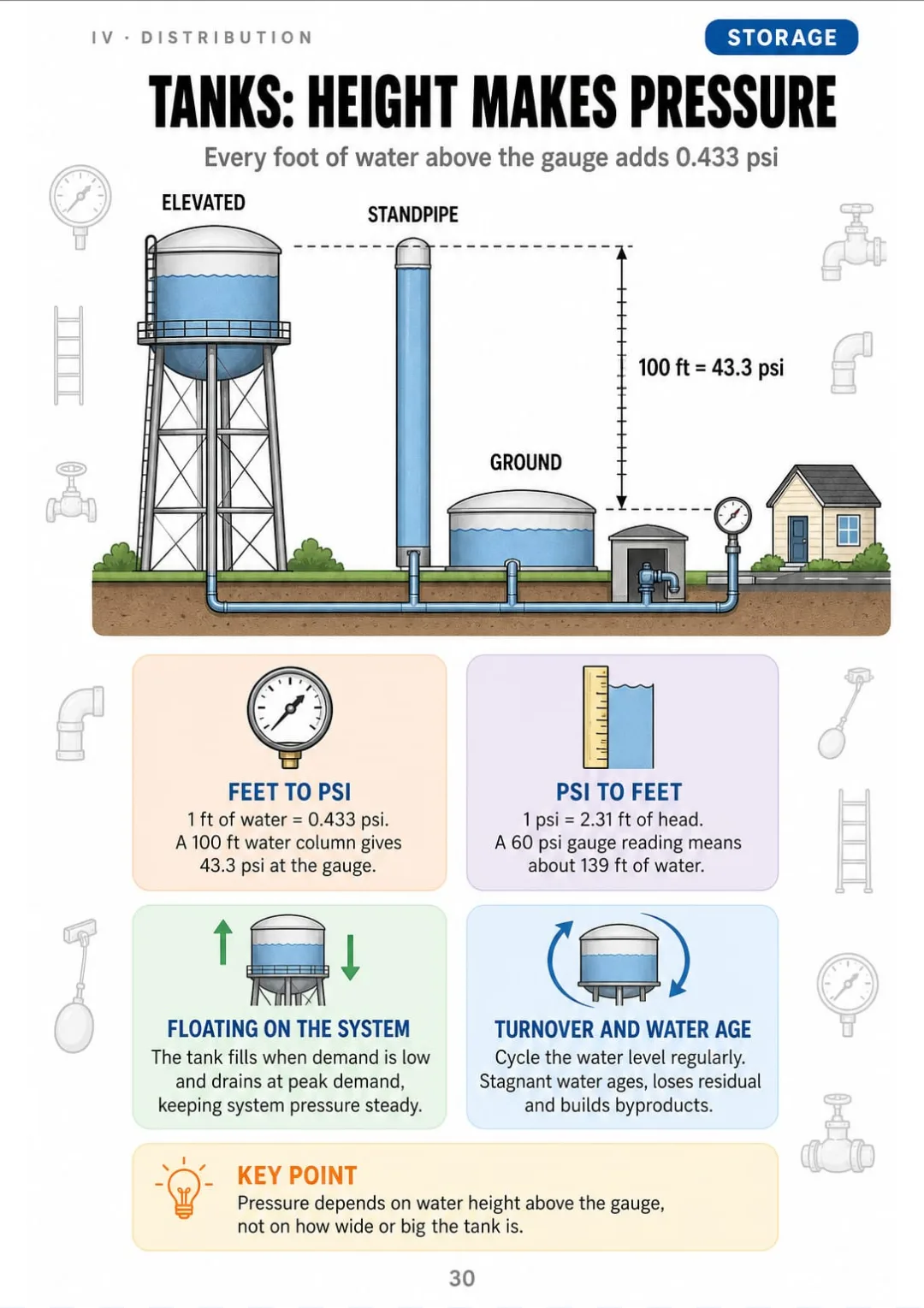
1 ft of water = 0.433 psi · 1 psi = 2.31 ft: why tanks float on the system
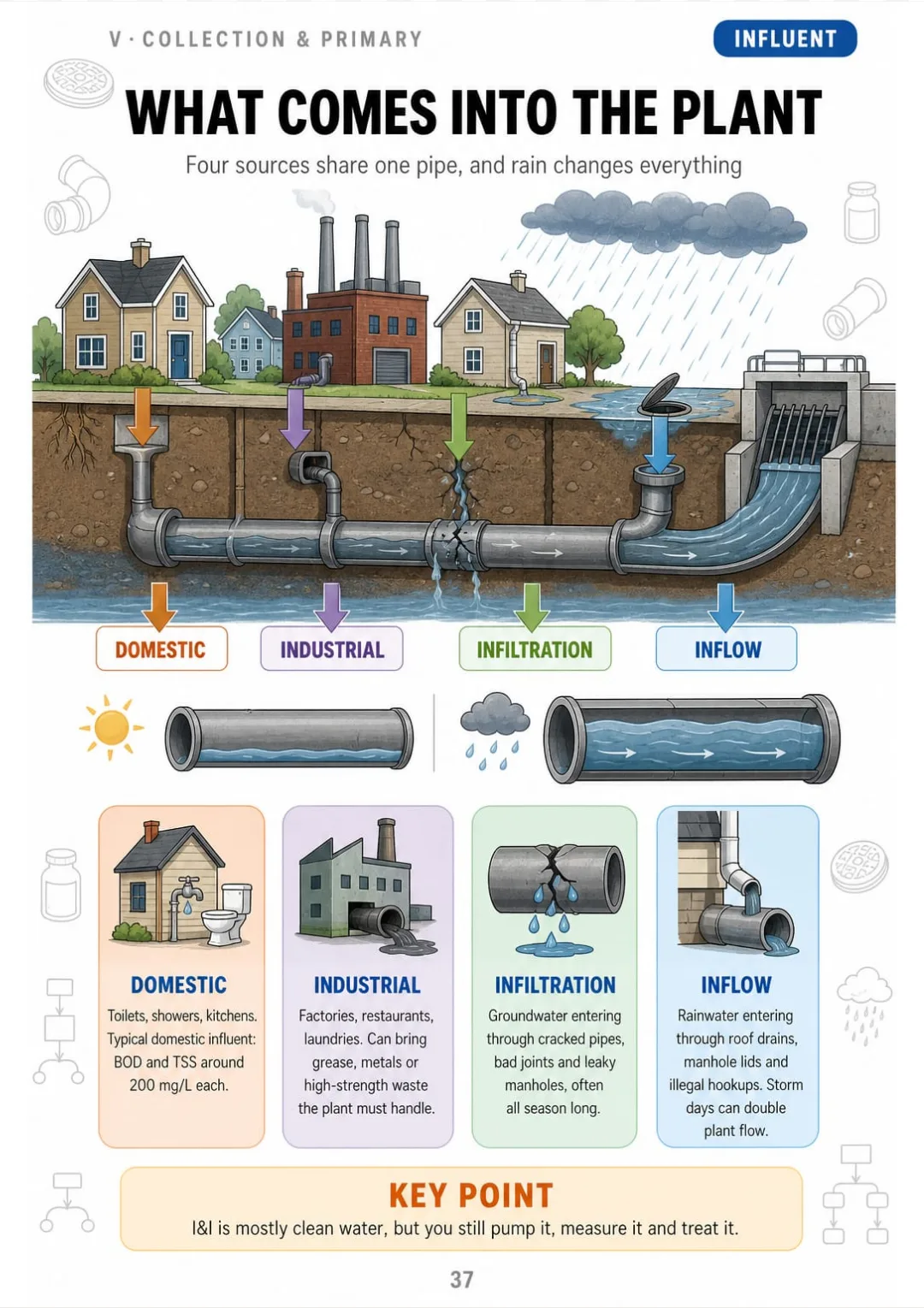
Domestic influent runs around 200 mg/L BOD and TSS; I&I can double the flow on storm days.
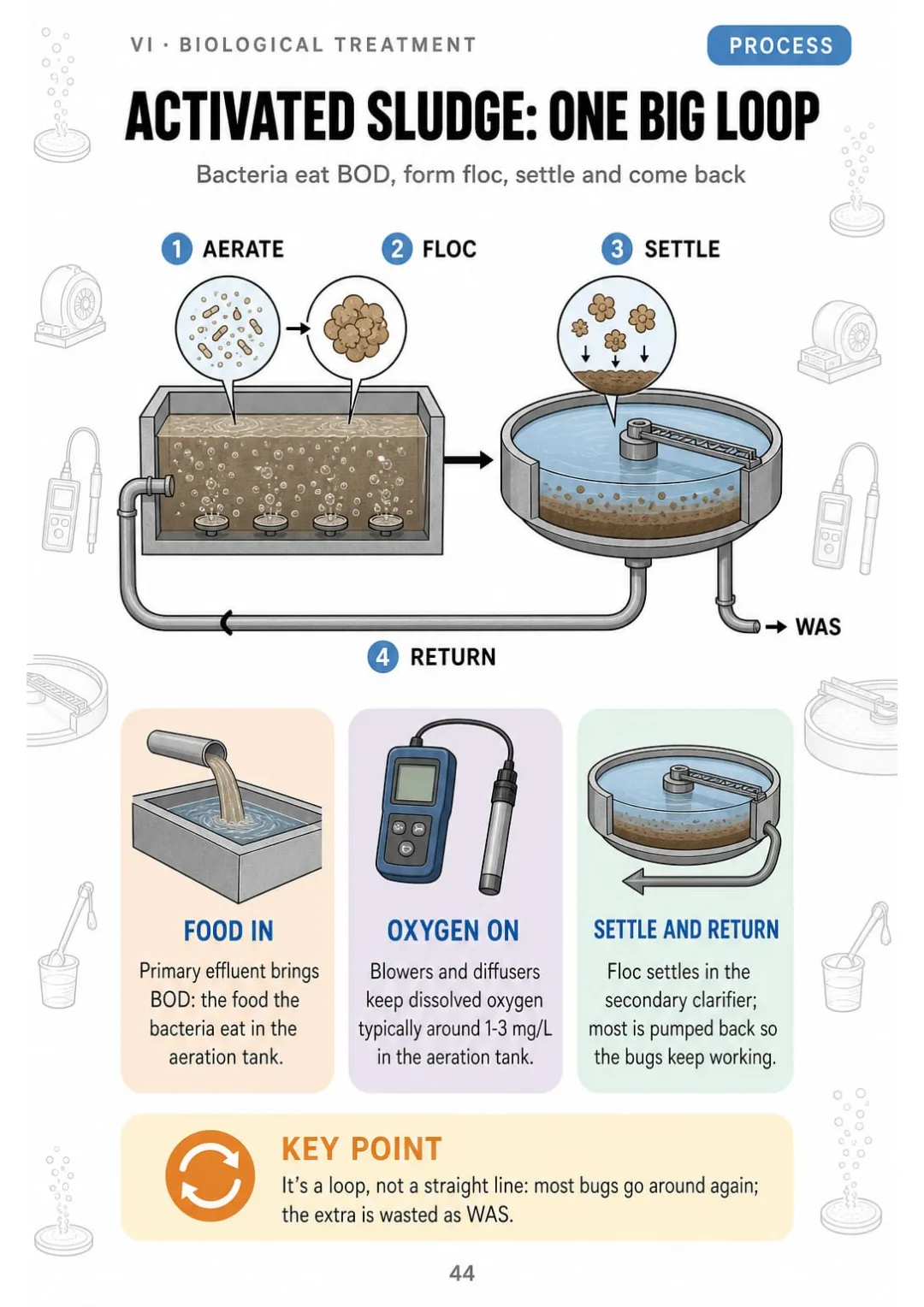
Aeration tank + clarifier + return sludge in one loop, DO typically 1-3 mg/L
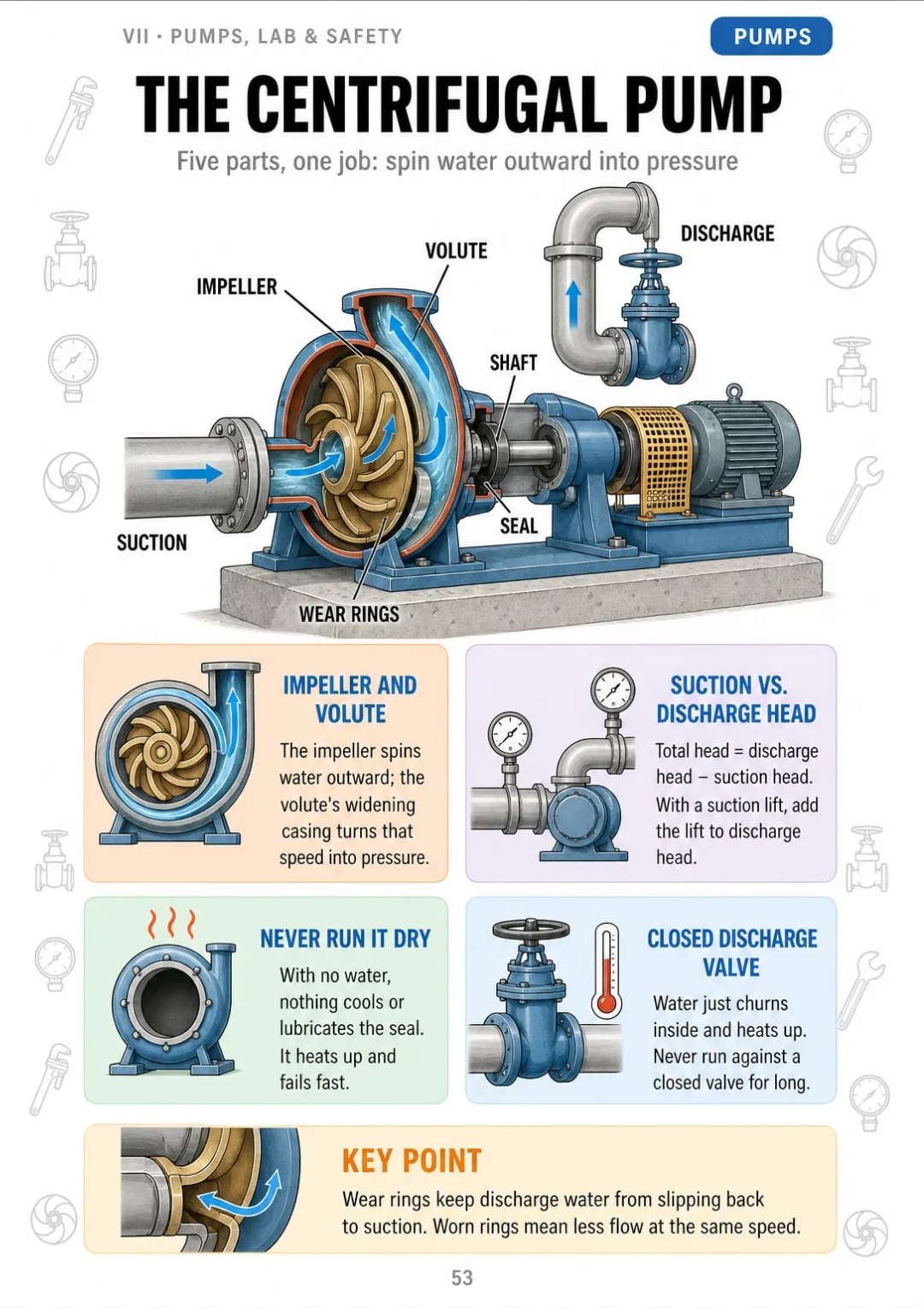
Impeller, volute, shaft, seal and wear rings in one cutaway
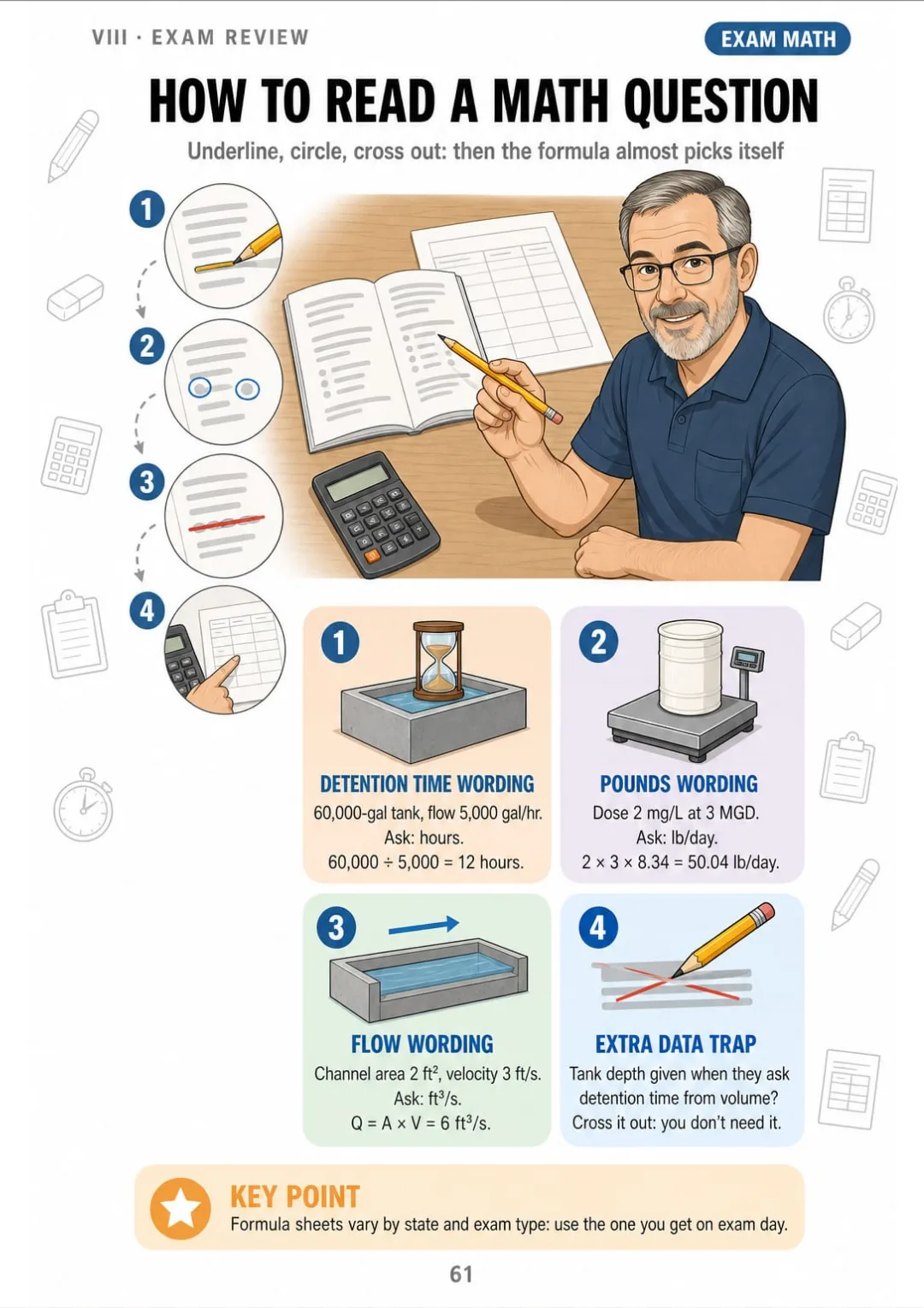
Underline the ask, circle units, cross out extras: detention time, pounds and flow solved in 4 steps

Swipe to see more →

These are real pages from the book. The table of contents is the full one: 8 parts and 61 topics.

The Problem Isn't You. It's How It Was Explained to You.

You're on a practice question: a well under the direct influence of surface water. Which rules apply? You know wells. You've sampled them. And you freeze.

The manual covers it in three dense paragraphs: sources, contaminants, GWUDI, exceptions. You read it at night after your shift, and by the next morning it's gone.

Surface water: turbidity and pathogens · Groundwater: hardness, iron, manganese · GWUDI = surface rules

In the book it's one page. A river on one side, a well on the other. Surface water brings turbidity and pathogens. Groundwater brings hardness, iron and manganese. And one arrow: GWUDI follows surface water rules.

Same with detention time, the pounds formula, breakpoint chlorination, RAS and WAS, and the centrifugal pump: each one has its own page.

You see it, you get it, and you answer without going back to the manual.

COMPARE FOR YOURSELF

Same Topic, Two Ways to Study It

THIS
  • The manual: line after line
  • Tank and pipe formulas explained only in words
  • Two readings later, you still can't find where the 0.785 comes in
The surface area of a circular basin, which constitutes a fundamental parameter in subsequent calculations of volume, surface overflow rate and weir loading, is determined through application of the expression A = πr², wherein r represents the radius, or alternatively by A = 0.785 D², in which the constant 0.785 is derived from π divided by four and D denotes the diameter. Rectangular basins are computed as length multiplied by width. Pipe cross-sectional area, expressed in square feet, requires prior conversion of the diameter from inches to feet before substitution into either expression.
FOR THIS
  • The clarifier area in one drawing
  • The 0.785 shortcut in a box
  • 60-ft clarifier: 2,826 ft², worked out on the page
60-ft clarifier: 0.785 × 60² = 2,826 ft², same as π × 30².
CONTENTS

Take a Look at the 8 Parts and 61 Topics

The map and the method, operator math, drinking water treatment, distribution and the rules, wastewater collection and primary treatment, biological treatment and solids, pumps, lab and safety, and exam review: 65 pages, all illustrated.

IStart Here: The Map and the Method · pp. 5-9
  1. The Whole Plant on One Map
  2. How Certification Works: Grades, Classes and Your State
  3. The 4-Step Math Method
  4. The Numbers You Use Every Day
  5. Units That Trip You Up
IIOperator Math, Step by Step · pp. 10-18
  1. Area of Tanks and Pipes
  2. Volume in Cubic Feet and Gallons
  3. Flow: Q = A × V
  4. Detention Time
  5. The Pounds Formula
  6. Dosage with Hypochlorite and Percent Strength
  7. Surface Overflow and Weir Loading Rates
  8. Filter Loading and Backwash Rate
  9. Percent Removal and Efficiency
IIIDrinking Water Treatment · pp. 19-29
  1. Sources: Surface Water vs. Groundwater
  2. Intake and Screening
  3. Coagulation: Neutralizing the Charge
  4. The Jar Test
  5. Flocculation: Building the Floc
  6. Sedimentation
  7. Filtration: Media and Head Loss
  8. Turbidity Rules for Filters
  9. Disinfection and CT
  10. Chlorine Chemistry and Breakpoint
  11. Iron, Manganese, Hardness and Fluoride
IVDistribution and the Drinking Water Rules · pp. 30-36
  1. Storage Tanks and Pressure
  2. Mains, Valves and Hydrants
  3. Cross-Connections and Backflow
  4. Residual in the System
  5. Coliform Sampling under the RTCR
  6. Disinfection Byproducts
  7. Lead, Copper and Public Notice
VWastewater: Collection and Primary Treatment · pp. 37-43
  1. What Comes into the Plant
  2. Collection System and Lift Stations
  3. Bar Screens and Comminutors
  4. Grit Removal
  5. Flow Measurement
  6. Primary Clarifier
  7. BOD, COD and TSS Explained
VIBiological Treatment and Solids · pp. 44-52
  1. Activated Sludge: The Bugs at Work
  2. MLSS, RAS and WAS
  3. F/M Ratio and Sludge Age
  4. The Settleometer and SVI
  5. Reading the Microscope
  6. Fixed-Film Systems
  7. Lagoons and Nutrient Removal
  8. Effluent Disinfection and Discharge Limits
  9. Sludge: Thickening, Digestion and Biosolids
VIIPumps, Lab and Safety · pp. 53-60
  1. The Centrifugal Pump
  2. Pump Problems: Cavitation and Packing
  3. Horsepower Math
  4. Routine Lab Tests at a Glance
  5. Sampling Right: Grab vs. Composite
  6. Chlorine Gas Safety
  7. Confined Spaces and Gases
  8. Lockout/Tagout
VIIIExam Review and Common Mistakes · pp. 61-65
  1. How to Read an Exam Math Question
  2. Frequent Math Mistakes
  3. Pairs That Get Mixed Up
  4. Troubleshooting Scenes
  5. The Night-Before Checklist

One Page, One Topic, All Clear

Think of it this way:

It's 2 a.m. on your shift and a practice question asks for the detention time of a 60-ft clarifier. You know that tank. You've walked around it a thousand times. The math is what stops you.

In the book you open the detention time page and see the tank drawn with its numbers: volume in gallons, flow in gallons per hour, divide, done. The same 4 steps every time: data, units, formula, result.

Domestic influent runs around 200 mg/L BOD and TSS; I&I can double the flow on storm days.

Same with the pounds formula, breakpoint chlorination, the jar test, the settleometer and SVI, and lockout/tagout: each one on its own page.

Water & Wastewater Operator Illustrated is 8 parts and 61 topics, all drawn, with exam math reading, frequent mistakes, troubleshooting scenes and a night-before checklist at the end.

What you see drawn, you don't have to memorize.

What's Inside Water & Wastewater Operator Illustrated:

Ipp. 5-9

Start Here: The Map and the Method

The whole plant on one map, how grades and state certification work, the 4-step math method, the everyday numbers and the units that trip you up.

IIpp. 10-18

Operator Math, Step by Step

Area, volume, Q = A × V, detention time, the pounds formula, hypochlorite dosage, overflow and weir rates, filter loading, backwash and percent removal. Every problem in the same 4 steps, so you always know where to start.

IIIpp. 19-29

Drinking Water Treatment

Surface water vs. groundwater, intake, coagulation, the jar test, flocculation, sedimentation, filtration, turbidity rules, CT, breakpoint, iron, manganese, hardness and fluoride.

IVpp. 30-36

Distribution and the Drinking Water Rules

Storage tanks and pressure, mains, valves and hydrants, cross-connections, residual, coliform sampling under the RTCR, disinfection byproducts, lead and copper.

Vpp. 37-43

Wastewater: Collection and Primary Treatment

What comes into the plant, lift stations, bar screens, grit removal, flow measurement, the primary clarifier, and BOD, COD and TSS.

VIpp. 44-52

Biological Treatment and Solids

Activated sludge, MLSS, RAS and WAS, F/M and sludge age, the settleometer and SVI, the microscope, fixed film, lagoons, effluent limits and biosolids. When RAS, WAS and sludge age come up, you see one loop instead of three definitions.

VIIpp. 53-60

Pumps, Lab and Safety

The centrifugal pump, cavitation and packing, horsepower math, routine lab tests, grab vs. composite sampling, chlorine gas, confined spaces and lockout/tagout.

VIIIpp. 61-65

Exam Review and Common Mistakes

How to read an exam math question, frequent math mistakes, pairs that get mixed up, troubleshooting scenes and the night-before checklist.

At the end of the book: How to read exam math questions, frequent math mistakes, mixed-up pairs, troubleshooting scenes and a night-before checklist.
Plus: 2 Free Books

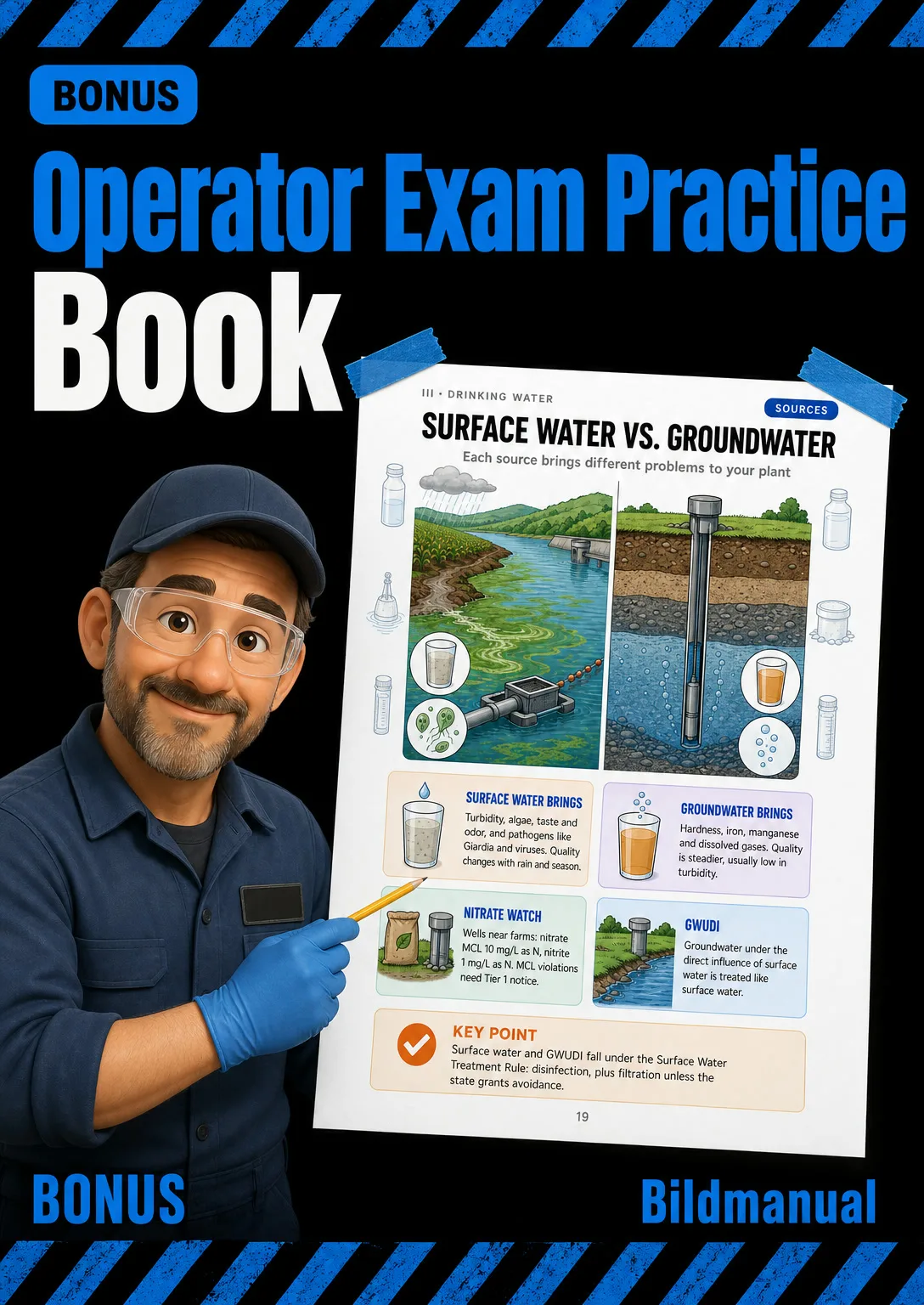
Operator Exam Practice Book

BONUS 1: «Operator Exam Practice Book»

Value on its own: US$ 17.90

Exam-style questions on treatment, wastewater, pumps, math and safety, with the answer explained right under each one so you see why, not just what.

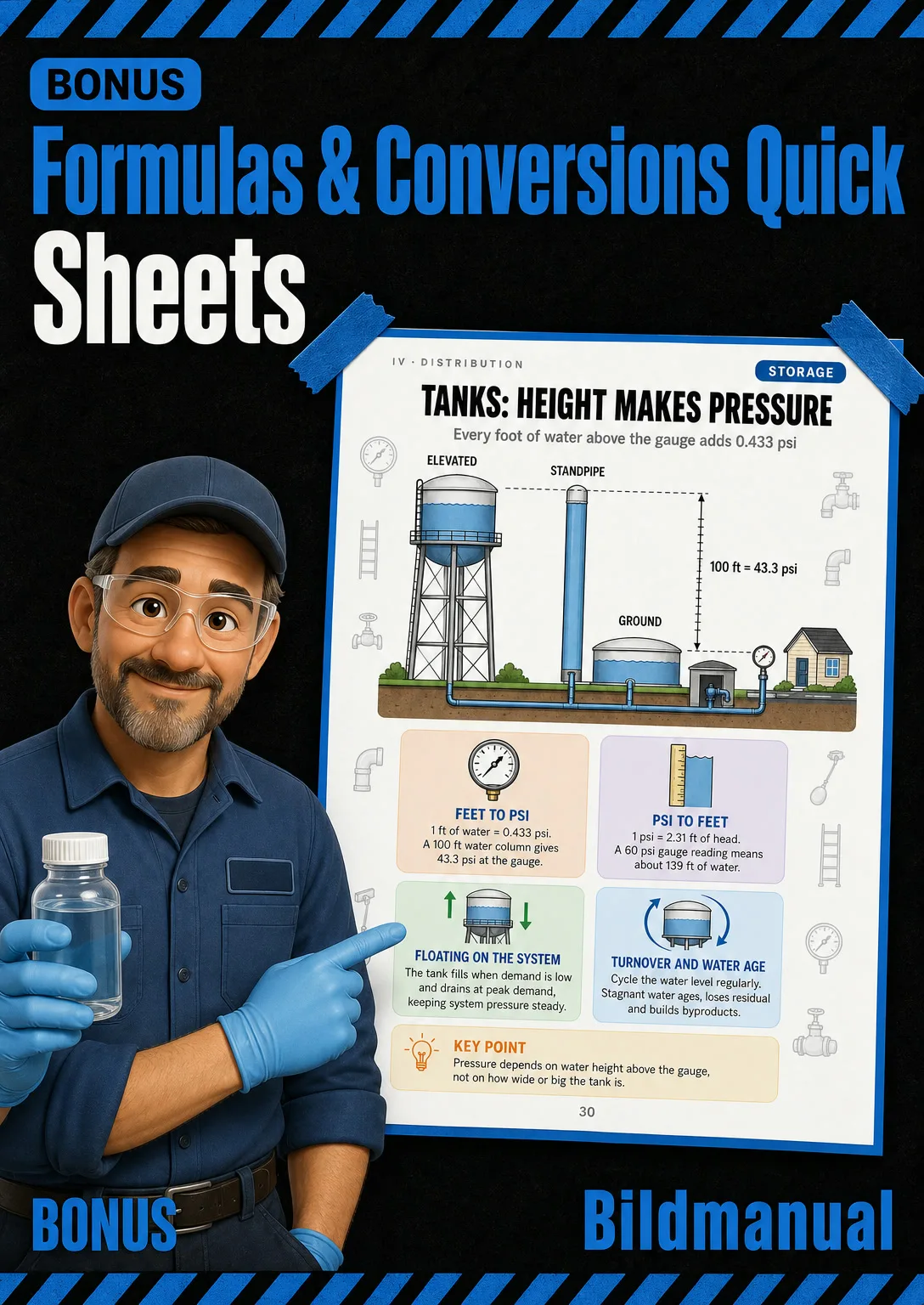
Formulas & Conversions Quick Sheets

BONUS 2: «Formulas & Conversions Quick Sheets»

Value on its own: US$ 14.90

Every formula and conversion factor you need (8.34 lbs/gal, 7.48 gal/ft³, gpm to MGD) on printable one-page sheets to review at a glance before the exam.

Water & Wastewater Operator Illustrated with 2 Free Books

  • Water & Wastewater Operator Illustrated: 65 illustrated pagesUS$ 63
  • BONUS 1: Operator Exam Practice BookUS$ 17.90
  • BONUS 2: Formulas & Conversions Quick SheetsUS$ 14.90
  • High-resolution PDF to printIncluded
Total value US$ 95.80
YOUR PRICE:
US$ 27
You save US$ 68.80
YES, I WANT WATER & WASTEWATER OPERATOR ILLUSTRATED FOR US$ 27

📄 This is a digital PDF book sent to your email: nothing is printed or shipped.

Secure purchaseEncrypted payment30-day guarantee

PDF by email: We email you Water & Wastewater Operator Illustrated as a PDF, together with the two free books. It's a single payment: no installments, no extra charges.

Who This Book Is For

You're an operator in training

You're an operator in training

You see the whole plant as one route, so every page you study has a place on the map you already walk.

Your state exam is coming up

Your state exam is coming up

You review the math with the same 4 steps every time and go over the numbers you need without digging through the manual.

You already run the plant

You already run the plant

You finally see why each stage works the way it does, and you have it printed to review or to hand to a new hire.

Everything You Get Today

US$ 95.80US$ 27
YES, I WANT WATER & WASTEWATER OPERATOR ILLUSTRATED FOR US$ 27

📄 This is a digital PDF book sent to your email: nothing is printed or shipped.

30DAYS
GUARANTEE

30-Day Guarantee

Try Water & Wastewater Operator Illustrated for 30 days, bonus books included.

We refund everything if the file won't open, if the book isn't what you see here, if you were charged twice or if the email doesn't arrive. Just email us.

You pay once. No subscriptions.

Frequently Asked Questions

Is it for me if I've worked at a plant for years but haven't studied in decades?

Yes. It follows the route of the water the way you walk it, and the math is solved with the same 4-step method. It covers drinking water and wastewater at the entry level (Grade I or II). If you're going for a higher grade, use it as a base review.

Where does the content come from?

From EPA regulations (40 CFR Parts 141, 133 and 503) and OSHA 29 CFR 1910.146 and 1910.147, cross-checked against the ABC need-to-know criteria for Class I-II operators. If a number can't be verified, it isn't in the book.

Is it official material?

No. It's an independent study book, not from the EPA, ABC or any state program, and it doesn't give you a certificate, CEUs or contact hours. It covers the core topics behind Grade I and II drinking water and wastewater exams (Class I and II on ABC exams). Many states use ABC exams and others write their own, so check your state's program for its exact rules and formula sheet.

Does it replace my certification course or training?

No. It's a study and review aid. It doesn't replace your course, on-the-job training, OSHA safety training or your plant's procedures.

Are the practice questions the ones on the exam?

No. They're written for this book to help you practice. They're not official questions from any exam.

When and how do I get it?

The book and the 2 bonus books arrive as PDFs by email, at the address you enter at checkout.

Do I have to pay every month?

No. It's a one-time payment.

Can I have it on paper?

Yes. The PDF is made to print, at home or at a print shop, so you can keep it in your locker or take it to the plant.

How does the refund work?

You have 30 days. We refund everything if the file won't open, if the book isn't what you see on this page, if you were charged twice or if the email doesn't arrive: just email us.

Before You Close This Page

No more rereading pages that don't stick.

The pounds formula: one drawing, and it makes sense.

You walk into the exam knowing where everything is.

Drawings make studying faster.

The book is right below.

One-time payment: US$ 27 · Guarantee: 30 days · PDF by email

YES, I WANT WATER & WASTEWATER OPERATOR ILLUSTRATED FOR US$ 27

📄 This is a digital PDF book sent to your email: nothing is printed or shipped.